
Why Your Plan Has a Deload Week You Didn't Ask For
It's Tuesday morning. You open TheNextHill, tap into your plan, and see today's session: a 40-minute Zone 2 run followed by hip and ankle mobility work. Next Tuesday, same slot, it's tempo intervals. Three weeks later, the whole plan shifts again. Shorter sessions, sharper intensity, a deload week you didn't ask for but probably need.
None of this is random. There's an engine behind it, and the decisions it makes are grounded in how endurance coaches have structured training for decades.
The backbone: traditional periodization
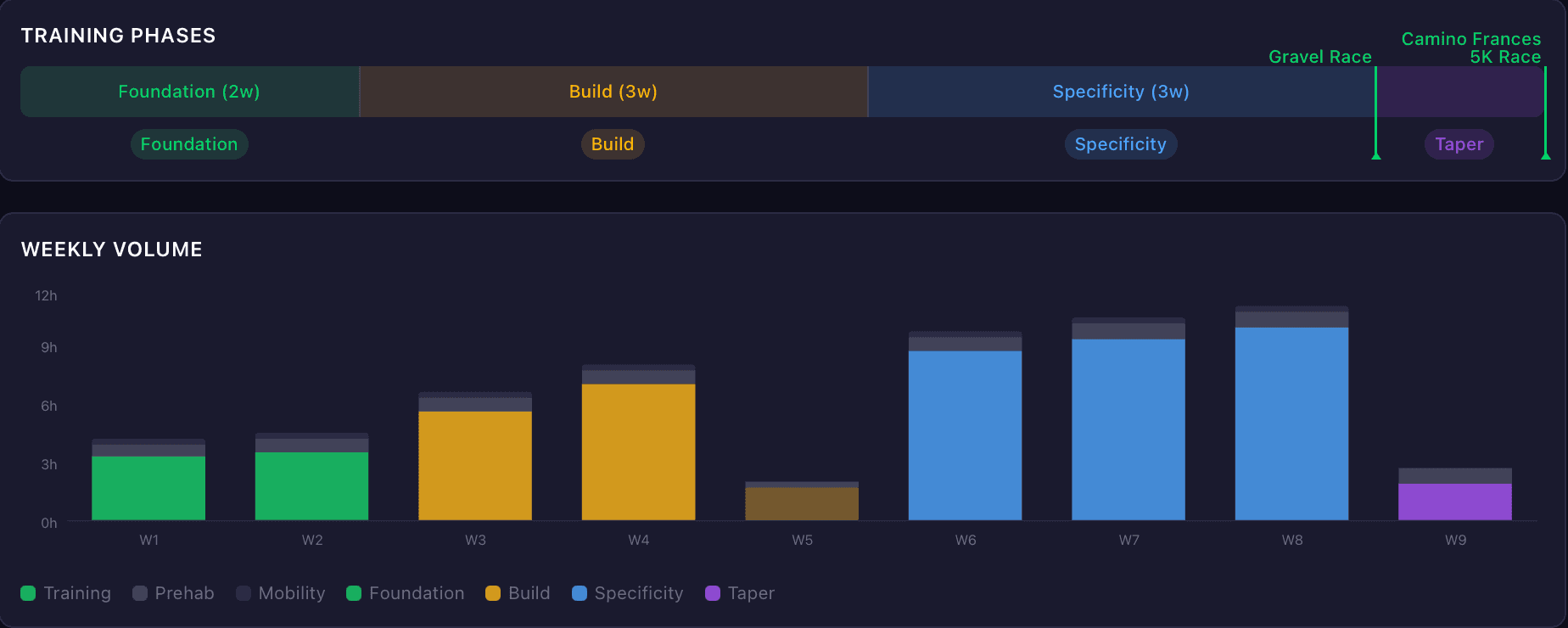
Every plan follows four phases: Foundation (easy volume, low intensity), Build (things ramp up), Specificity (training that mirrors your actual adventure), and Taper (volume drops so your body absorbs the work). Roughly 30/35/25/10 percent of total plan length. On an 18-week plan, that's five weeks of base, six of progressive overload, five of adventure-specific work, and two of controlled recovery before your event.
This structure has been the dominant model in endurance sport since the 1960s. Olympic distance runners, professional cyclists, world-class cross-country skiers. They still organize their seasons this way because it keeps working: build an aerobic base early, sharpen toward race fitness later.
Why not something newer?
Block periodization gets attention. Concentrate on one quality at a time: pure strength, then VO2 max, then race-specific speed. It can work, particularly for athletes juggling multiple peaks in a season.
But for the person training toward a single adventure over 12 to 24 weeks? Traditional periodization solves the right problems. It's predictable, easy to follow, and sturdy enough to absorb the disruptions of real life: a bad knee, a work trip, a week where sleep falls apart. A recent review of periodization across Olympic endurance sports found it still dominates at the elite level. Not because coaches are stuck in the past, but because it keeps solving practical problems that flashier models skip over. The best coaches use it as the skeleton and adapt everything else around the athlete in front of them.
That's what our engine does.
Where it gets personal
The traditional structure is the skeleton. The individualization is the muscle.
When your plan generates, the engine analyzes the gap between your current fitness (from your Garmin data or manual scores) and what your target adventure demands across four dimensions: cardiovascular fitness, muscular strength, altitude tolerance, and duration stamina. Your weakest dimension gets the most training slots. Your strongest gets maintenance work. Two people training for the same adventure will get completely different session mixes, because their gaps are different.
Plan length scales to readiness. If you're already 75% ready for a half marathon, you don't need a 24-week plan. You need six focused weeks. If you're at 25% readiness for Kilimanjaro, the engine gives you the full runway.
Sessions adapt to what you actually have. No gym? Bodyweight alternatives. No resistance bands? The prehab sessions adjust. Training for a multi-day trek? You'll see consecutive walking days with a loaded pack in the Specificity phase, because that's what the adventure demands. Training for a century ride? Back-to-back riding days appear in Build and increase in frequency as you approach race day.
Every third week in the Build phase, volume drops 30%. You didn't ask for a deload. You might not feel like you need one. I never did either, until I kept getting injured in week six of every training block I tried. The research on master athletes backs this up: recovery is where adaptation happens, and the 50+ body needs more of it than the 30-year-old body does.
What the phases actually feel like
Foundation is the phase where nothing feels hard enough. You'll wonder if the plan is broken. It's not. You're building the aerobic base and connective tissue resilience that everything else sits on top of, and if you skip this part you'll feel it in week eight. No hard efforts yet. Two strength sessions a week. Prehab and mobility on easy days.
Build is where things get interesting. Two high-intensity sessions per week appear and volume climbs. The deload weeks land every three weeks, cutting volume but keeping one hard session to maintain sharpness. If you're training for a trek, intensity looks different: loaded carries and sustained Zone 2 walking rather than VO2 max intervals.
Specificity feels most like the adventure itself. Multi-day trek? Full pack, real boots. Long cycling event? Practicing nutrition on the bike and riding consecutive days. Volume holds near its peak but doesn't climb further.
Taper is short and aggressive. Volume drops to roughly half of peak, sessions go from four or five per week down to two or three, and you keep one hard session to stay sharp. Your fitness is banked. The job now is to arrive fresh.
The honest version
No training plan survives contact with real life. Injuries happen. Work gets busy. Sleep falls apart for a week. The structure matters because it gives you something to return to when things go sideways. Miss a week in Build? You know where you are in the progression and you pick up where you left off. The plan doesn't collapse because you skipped three sessions.
Traditional periodization has survived sixty years of alternative models for a reason. It is simple enough to follow, structured enough to be effective, and flexible enough to absorb the chaos of being a real person with a real schedule and a body that doesn't always cooperate.
We built the engine on that foundation. Your gaps, your gear, your adventure, and your timeline make it yours.
Found this useful? Share it.


