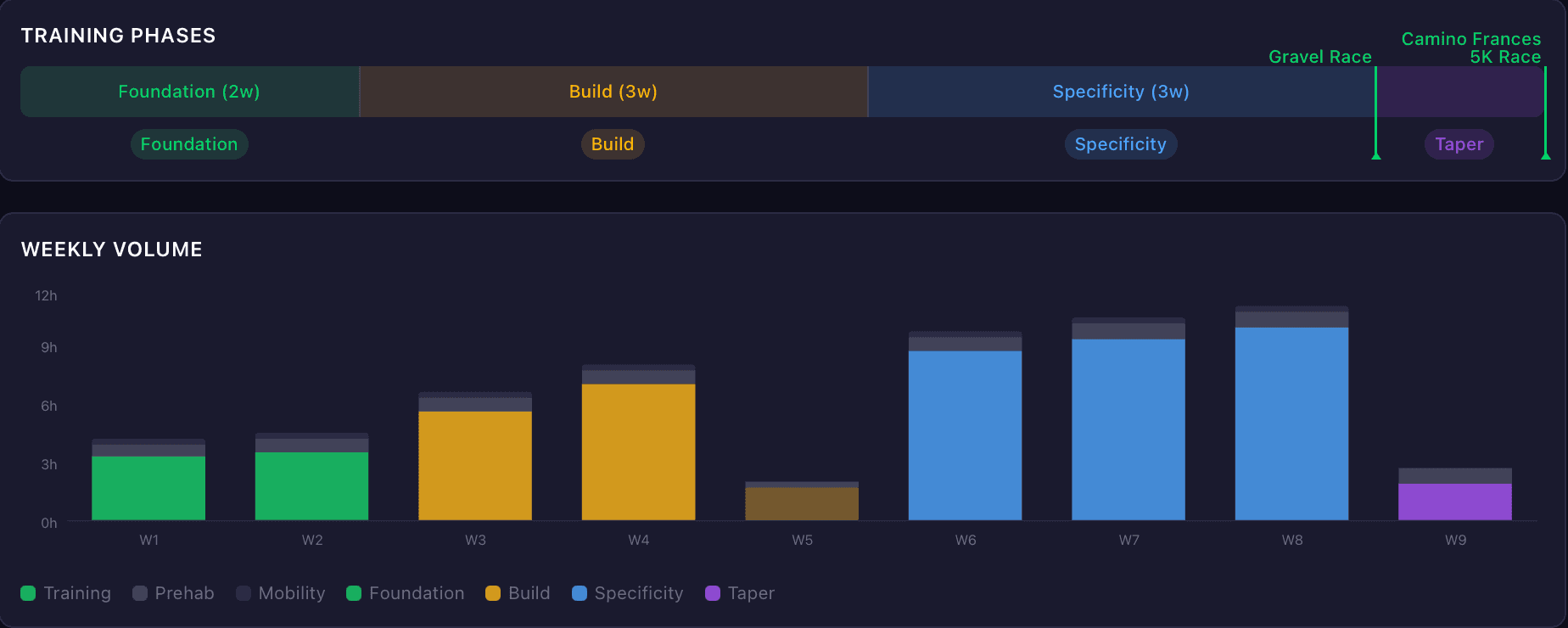
Progressive Overload for Adventures: A 10-Year Framework
Most people approach adventures the same way they approach New Year's resolutions: with enthusiasm and no plan. They pick something ambitious, maybe train for a few weeks, and either pull it off through sheer willpower or shelve it when life gets in the way.
I've done both. I've shown up wildly unprepared (motorcycling Sydney to London on six weeks' notice comes to mind) and I've built toward things over years (a 70.3 Ironman, backcountry flying in Idaho). The difference in how those experiences felt wasn't even close. The ones I built toward were better in every way: safer, more satisfying, and honestly more fun because I wasn't just surviving them.
The principle: progressive overload for adventures
Athletes have understood progressive overload for decades. You gradually increase training stress so your body adapts and gets stronger. The same principle applies to adventures. A 5K builds the base for a half marathon. A weekend trek builds the base for a week-long hut-to-hut route. Coastal sailing prepares you for an offshore passage.
The mistake is skipping levels. Going from couch to Kilimanjaro in six months is technically possible, but your experience will be worse, your injury risk will be higher, and you'll miss the satisfaction of feeling genuinely prepared. I've seen this pattern across 40+ countries and every adventure type I've tried: the people having the best time are the ones who built up to it.
Year 1: Build the foundation
Your first year is about establishing baseline fitness and discovering what actually excites you. Try several different adventure types: a day trek, a short cycling tour, a sailing taster, a trail run. You're not committing to a discipline yet. You're exploring.
Good Year 1 goals: complete a 5K or 10K run, do a multi-day walk (a section of the Camino, the Cotswold Way), take a weekend sailing course, join a group cycling ride of 50+ km. All achievable from a moderate fitness base.
Year 2: Prove endurance
Now you know what excites you. Year 2 is about going longer and harder within your chosen types. If trekking lit you up, do a week-long route. If cycling clicked, train for a multi-day tour. The goal is to prove to yourself that you can sustain effort over consecutive days.
This is also the year to get serious about supporting fitness. If you're trekking, add structured strength training. If you're cycling, work on your core and flexibility. The auxiliary work you do in Year 2 pays compound dividends in Year 3 and beyond. It's boring. It matters more than anything else you'll do.
Year 3-4: Reach for the signature adventures
With two years of progressive building, you're ready for the adventures that used to feel like dreams. The Tour du Mont Blanc. A half Ironman. A week of island-hopping by sea kayak. An ascent of a 4,000-meter peak.
These adventures aren't just harder. They're more rewarding because you arrive with genuine competence. You know how your body responds to consecutive hard days. You know your gear. You've developed the judgment that only comes from accumulated experience, the kind you can't shortcut.
Year 5+: Go further or go deeper
After four years, you have a choice. Keep pushing the envelope: Kilimanjaro, the Haute Route, Patagonia, a full Ironman. Or go deeper into what you love. Become a skilled mountaineer. Cross an ocean under sail. Mentor others on their first treks. When I sailed the Indian Ocean, I wasn't checking off a list. I was following a thread that started years earlier on smaller water.
The beauty of a long-term plan is that it's not rigid. Life happens: injuries, family changes, shifting interests. A 10-year horizon gives you room to adapt while maintaining forward momentum. Miss a year? You haven't failed. You've adjusted the timeline.
Making it concrete
A plan only works if it's specific enough to act on. For each year, identify:
- One or two target adventures with actual dates or seasons
- The fitness benchmarks you need to hit before each one
- The training plan to get there (weekly structure, not just intention)
- One skill to develop (navigation, rope work, bike maintenance, weather reading)
Write it down. Review it quarterly. Adjust as you learn more about yourself.
The plan isn't a contract. It's the thing that turns "someday" into a date on a calendar and a training block on your schedule. That's where adventures stop being fantasies and start becoming inevitable.
Found this useful? Share it.