I Scored My Life Across Ten Dimensions. The Gaps Surprised Me.
I've been lucky to have had some great experiences in my life: I got to motorcycle from Sydney to London, to sail across the Indian Ocean, to have a career I loved, to complete a 70.3 Ironman, to fly a plane around the Idaho backcountry, to visit 40-odd countries and to stay married to the same extraordinary woman for 34 years.
On paper, not a bad life. But is it enough? Could I do more? Live more? Squeeze more? I asked myself:
Are you measuring success the wrong way?
Most people measure their lives by happiness or meaning. But psychologists have identified something better: richness. Not a third option alongside happiness and meaning, but a more complete measure of a life well-lived.
A rich life is full of diverse, perspective-changing experiences. It has texture, depth, and range. You can be happy on autopilot. You can find meaning in a narrow lane. But richness requires the whole map.
So I used AI to help me build a model that could measure my own life against what the research actually said. Ten dimensions, each scored 0 to 100, grounded in five bodies of peer-reviewed evidence.
The shape of a lopsided life
The results were not what I expected.
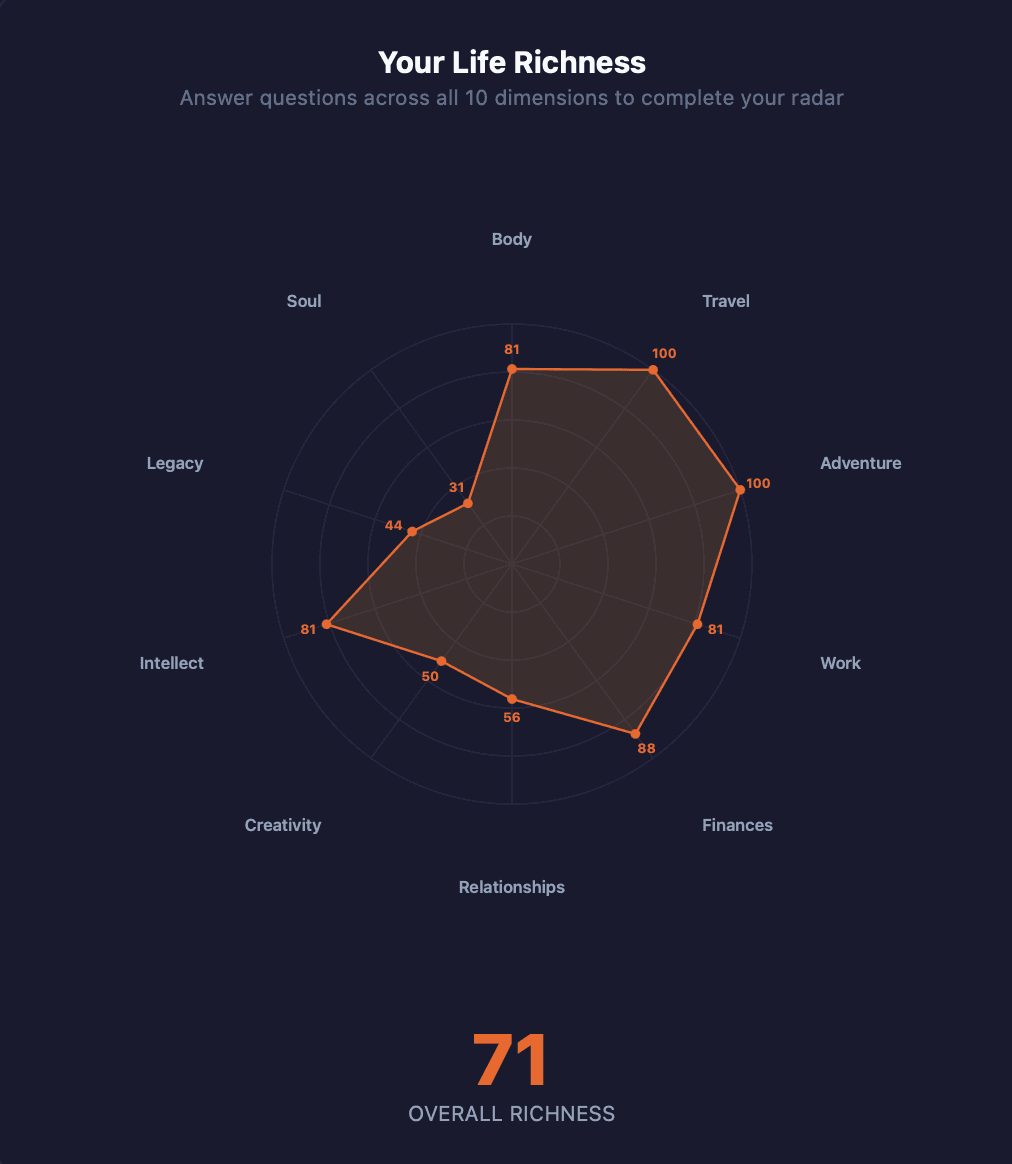
In the dimensions you'd guess, I scored well. Adventure depth: 96. Financial sovereignty: 97. Physical mastery: 92. The right side of the radar chart looked impressive.
Then I looked at the left.
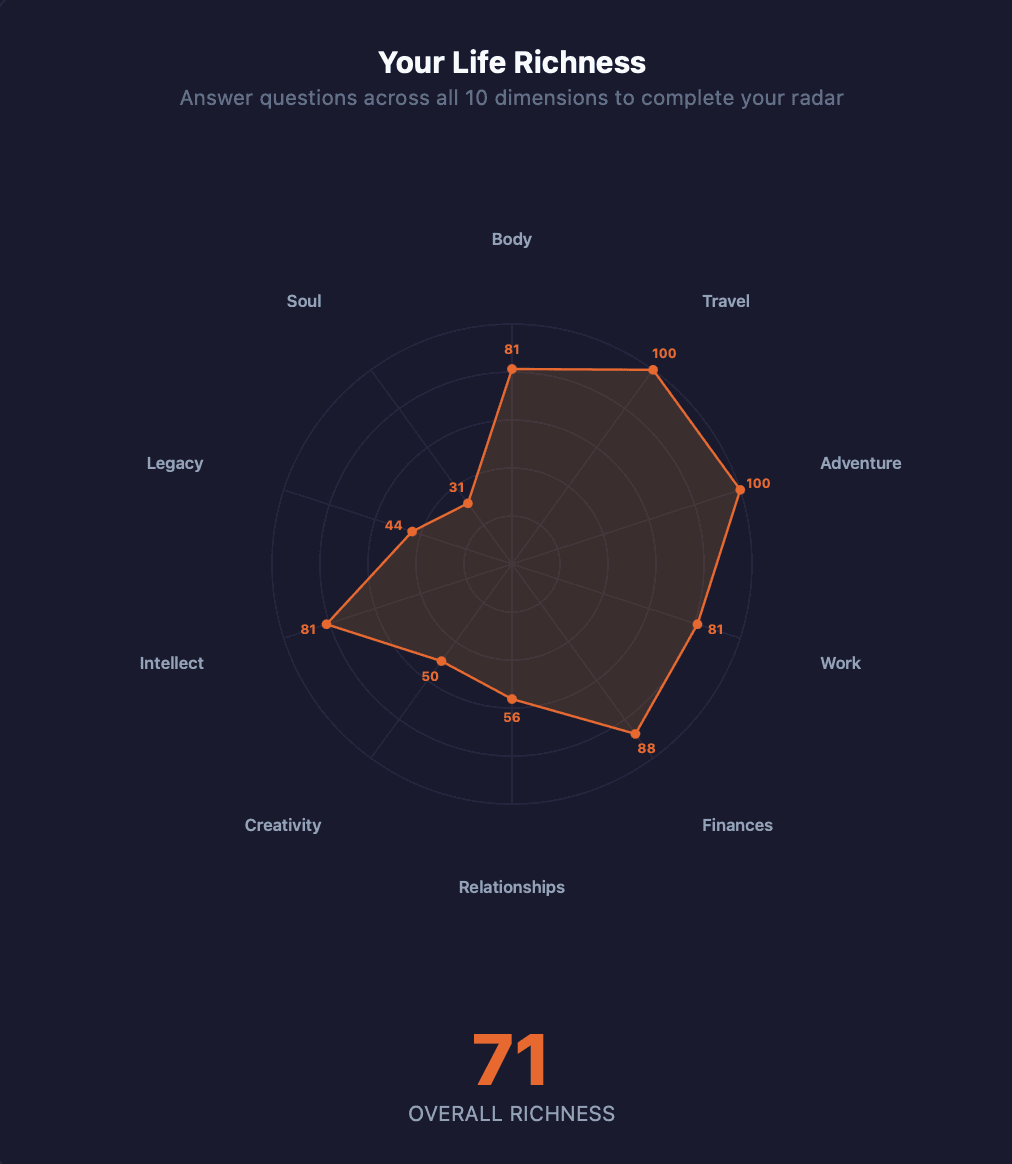
Inner Life (my capacity for reflection, presence, being comfortable without a project to optimize): 35 out of 100. Legacy and Contribution (what I've created that will outlast me, who I've mentored, what I've given back): 55. Creative Expression, despite years of photography, painting, poetry, and a half-written memoir: 68. The gap wasn't in what I'd done. It was in who I'd become while doing it.
I'd built an extraordinary life of doing. The research says the next chapter should be about being, giving, and finishing.
The five pillars underneath the model
The framework draws on research I wouldn't have connected without AI helping me synthesize it. Shigehiro Oishi at the University of Chicago identified "psychological richness" as a third dimension of wellbeing, characterized by diverse, perspective-changing experiences. The Harvard Grant Study tracked men for 87 years and found that relationships at 50 predict health at 80 more reliably than cholesterol levels. Erik Erikson's developmental stages show that contributing to the next generation is the single strongest predictor of late-life peace. Dan Buettner's Blue Zones research identified nine principles shared by the world's longest-lived communities. And Experiential Diversity Theory demonstrates that the variety of experiences, not just the volume, predicts resilient aging.
AI helped me map these into ten measurable dimensions: Physical Mastery, Geographic Range, Adventure Depth, Professional Achievement, Financial Sovereignty, Relationships and Love, Creative Expression, Intellectual Depth, Legacy and Contribution, and Inner Life. Then it scored me honestly against each one.
Five moves that would change the map
The model doesn't just diagnose. It prescribes. Based on the gap analysis, five actions would shift my radar chart more than any new adventure: finish my memoir; start a daily ten-minute meditation practice; establish a regular mentoring commitment; schedule monthly dinners with the same group of friends; pick one intellectual domain and read twelve books in twelve months.
No plane ticket required. No new gear. Just the harder kind of work: the kind that happens when you stop moving long enough to feel what all the movement meant.
Why I'm building this for others
I'm 60. I had heart surgery six months ago. I'm training for a marathon in October and building a platform called TheNextHill.com that started as an adventure readiness website.
But this exercise (the research, the AI-assisted modeling, the uncomfortable radar chart) changed what the platform wants to be.
The question "What's your next hill?" used to mean which mountain, which race, which country. Now it means something bigger: which dimension of your life needs attention next?
I want my kids and their kids to have this map before they're 60. Not after.
That's the whole point, really.
Want to see the shape of your own life?
Take the 10-minute Life Richness assessment: ten dimensions, grounded in five bodies of research. See where you're full, and where there are gaps you might not expect.
Take the QuizDavid Rabjohns is the founder of TheNextHill (thenexthill.com). He splits time between Illinois, Idaho, and Florida, and is currently working on a memoir called Fear-Less about a motorcycle journey from Sydney to London.
Found this useful? Share it.