Standing on the Shoulders of Giants: The Science Behind Our Training Engine
I'm not an exercise physiologist. I'm a software engineer who spent a decade on motorcycles, sailboats, and triathlon start lines, then needed a way to turn wearable data into a training plan for the adventures I cared about. Nobody was building that. So when I sat down to build the engine myself, I did what any honest engineer would do: I read the literature, implemented the models, and tried to get out of the way of the science.
This post is a technical walkthrough of what's under the hood. If you work in exercise science or coach masters athletes, I'd genuinely welcome the scrutiny.
The Problem We're Solving
TheNextHill helps people over 50 choose an adventure (a marathon, a trek to Everest Base Camp, an IRONMAN, a summit of Mont Blanc) and build a training plan to get ready for it. The system ingests wearable data (primarily Garmin), scores the user's current fitness across four dimensions, compares that to the adventure's demand profile, and generates a periodized, gap-driven plan.
The four dimensions: Cardiovascular Fitness, Muscular Strength and Endurance, Altitude Tolerance, and Duration/Stamina.
Every adventure in the library carries a demand profile across these four dimensions, scored 1-10. A Marathon des Sables might be cardio=9, strength=7, altitude=3, duration=10. A Gran Fondo might be cardio=7, strength=4, altitude=2, duration=7. These profiles are calibrated by hand, audited against real event data, and held to a simple rule: don't inflate difficulty to seem impressive.
Readiness Scoring: A Sigmoid Completion-Probability Model
The core of the readiness system is a per-dimension sigmoid function that models the probability an athlete can handle a given demand level:
P(completion) = 1 / (1 + e^(-12 * (ratio - 0.76)))
Where ratio = user_score / adventure_demand.
The sigmoid parameters (k=12, midpoint=0.76) are calibrated to produce completion probabilities that match real-world outcomes:
- Ratio 1.0: 100% (meets demand)
- Ratio 0.85: 76% (slightly under, likely fine)
- Ratio 0.75: 47% (moderate gap, coin flip)
- Ratio 0.60: 13% (large gap, likely DNF)
This isn't novel. It's a standard logistic model. But it does two things well for our use case: it's generous near the top (you don't need a perfect score to be ready) and it's brutally honest at the bottom (a 60% fitness-to-demand ratio gives you a 13% chance, and that feels right to anyone who's been pulled off a mountain).
Overall readiness uses a weakest-link approach. The composite score is driven by the minimum across all dimension probabilities, with a demand-weighting layer: high-demand dimensions (7+) retain full bottleneck power, while low-demand dimensions (1-2) are blended toward 1.0 so they can't drag the score unfairly. A gravel race with altitude demand of 2 shouldn't penalize a rider who trains at sea level.
Garmin Signal Mapping: Multi-Signal, Weighted, Credibility-Adjusted
Each dimension is scored from 3-5 Garmin signals with configurable weights. For cardiovascular fitness:
- VO2 Max (35% weight): Garmin-reported, scaled from 25-55 mL/kg/min to 1-10
- Endurance Score (25%): Garmin's proprietary 0-5000 metric
- Aerobic Training Effect (20%): 0-5 scale from recent activities over a 90-day window
- Resting Heart Rate (20%): 40-80 BPM, inverted
Every signal is multiplied by a training credibility factor (0.2 to 1.0) based on recent meaningful training frequency. "Meaningful" means sessions with Aerobic Training Effect >= 3.0, Garmin's "Improving" threshold. The credibility model uses a 45-day decay window.
This matters enormously for our audience. A 58-year-old returning from surgery or injury may still show a respectable VO2 Max (the number decays slowly) and decent resting heart rate. Without credibility adjustment, the system would tell them they're ready for things they absolutely are not. Credibility scaling ensures that stale metrics are attenuated until fresh training data confirms them.
Four Scoring Layers for Adventure-Specific Readiness
On top of the base sigmoid model, four additional layers adjust the readiness score for adventure-specific context:
1. Cross-Sport Modality Transfer Matrix. A cyclist training for a running adventure gets partial credit. The transfer coefficients are dimension-specific: cycling transfers well to running cardio (0.5) and duration (0.4), but poorly to running-specific strength (0.4) and altitude (0.5). A 0.6 floor prevents over-penalization for cross-modal athletes. The matrix covers running, cycling, hiking, swimming, and triathlon as both source and target modalities.
This is inspired by the transfer-of-training literature, particularly the principle that central cardiovascular adaptations transfer across modalities while peripheral muscular adaptations are more mode-specific.
2. Duration Sufficiency Gate. If the user's longest matching-modality effort is less than 75% of the adventure's peak day duration, the Duration dimension takes a -1.5 to -3 point penalty. You can't fake long-day fitness. The mapping from duration demand (1-10) to expected peak hours is calibrated from real adventure profiles.
3. Altitude Band Modifier. Proven altitude experience (from Garmin elevation data and hiking frequency) is compared against the adventure's altitude demands. The modifier ranges from 1.0 (proven at or above target) down to 0.5 (no experience above 3,000 m / 9,800 ft gap). The stepping-stone model uses 1,500 m (4,900 ft) bands, reflecting the acclimatization literature on progressive altitude exposure.
4. Per-Modality Recency Credibility. A 45-day half-life decay that only counts matching-modality sessions. A swimmer's recent VO2 Max data gets attenuated when assessing running adventure readiness, even if the raw number looks good.
Periodization: Classic 4-Phase, Gap-Driven
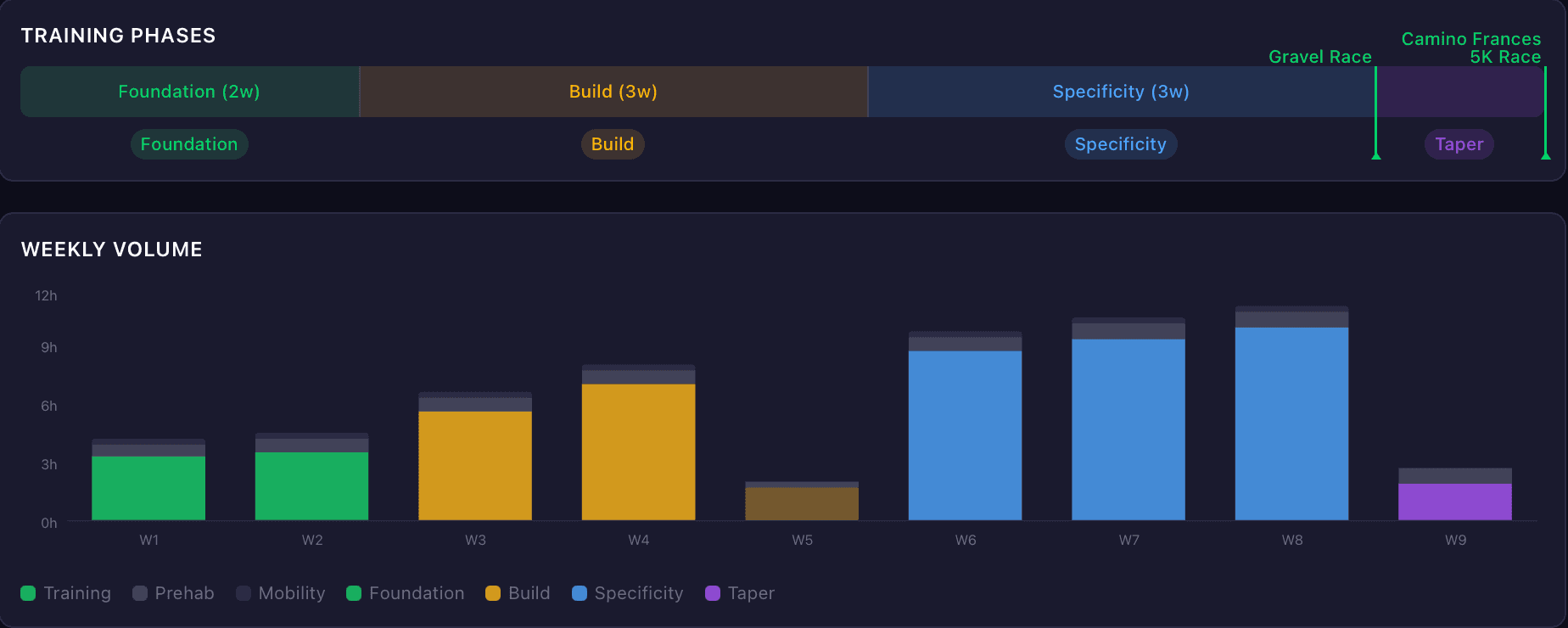
The plan engine uses a classic 4-phase block periodization model:
- Foundation (30% of plan): Aerobic base building, light intensity. One low-dose VO2 Max touch per week (strides or short fartlek) for neuromuscular maintenance. This reflects the well-documented ~1%/year VO2 Max decline in masters athletes and the evidence that even minimal high-intensity stimulus preserves fast-twitch recruitment.
- Build (35%): Progressive intensity targeting the weakest dimensions. Deload every 3rd week. Intensity distribution shifts to 60-70% easy, 30-40% mixed intensity.
- Specificity (25%): Adventure-specific simulation. Longer efforts, adventure-specific gear, combined dimensions. Recovery week every 3rd week.
- Taper (10%): Volume reduction while maintaining intensity. Distance-aware taper scaling: 5K-10K gets 1 week, marathons get 2, ultras get 2-3.
Plan length is dynamic, calculated from the gap between current readiness and adventure demands: a 90%+ ready athlete gets a 2-week plan, a 25% ready athlete gets 24 weeks. Difficulty tier floors apply (16 weeks minimum for challenging adventures, 20 for extreme).
What We Rejected (and Why)
Some of the most important decisions were about what not to implement.
Sustained threshold training (the "gray zone"). Early versions of the engine prescribed Z3 tempo runs. A masters training audit flagged this as the least productive training zone for 50+ athletes. We replaced sustained threshold with Z4 cruise intervals (RPE 8, with jog recovery between efforts). The work of Seiler and others on polarized intensity distribution was directly influential here. For our audience, time in the gray zone carries disproportionate fatigue cost relative to adaptation.
TRIMP as the load metric. We chose HR-based TSS over Banister's TRIMP model. The TSS framework (effort = duration_hours x (avgHR/LTHR)^2 x 100) feeds into a standard CTL/ATL/TSB model with 42-day and 7-day EWMA windows. CTL provides the chronic fitness estimate, ATL the acute fatigue, and TSB (CTL minus ATL) the form indicator. For our multi-sport, multi-adventure audience, TSS normalizes better across modalities.
Linear and undulating periodization. We implemented classic block periodization only. For an audience training toward a specific event date (an adventure with a departure day), block periodization's clear phase transitions and progressive specificity are more appropriate than daily undulation. The plan needs to be legible to the athlete, not just physiologically optimal.
Training Load Safety: ACWR and Recovery Rules
The weekly report engine calculates Acute:Chronic Workload Ratio (ACWR) using 7-day acute and 28-day chronic windows:
- 0.8-1.0: Safe
- 1.0-1.3: Optimal loading
- 1.3-1.5: Caution
- Above 1.5 or below 0.8: Danger zone
For our 50+ audience, recovery rules are conservative: minimum 2-3 rest days per week for all adventure types, no back-to-back high-intensity sessions unless max demand > 7 and duration > 6, deload weeks every 3-4 weeks in Foundation and every 3 weeks in Build and Specificity phases.
The ACWR model has known limitations (the 28-day rolling average can mask within-window spikes) but it provides a useful guardrail, and the color-coded risk zones in weekly reports give athletes a simple decision framework.
Masters-Specific Adjustments
Several design decisions are specifically calibrated for 50+ athletes:
BMI soft zone. The first 2 BMI points above optimal range are penalized at half rate. Body composition shifts with age, and a rigid BMI cutoff would over-penalize athletes who are genuinely fit but carry more mass than they did at 30.
VO2 Max preservation. Mandatory strides or fartlek in the Foundation phase. This isn't about building VO2 Max (that comes in Build). It's about maintaining neuromuscular capacity and fast-twitch fiber recruitment, which decline ~2x faster than pure strength in masters athletes.
Power development templates. Dedicated power sessions (box jumps, medicine ball slams, explosive swings) with the explicit instruction: "If any rep feels slow, stop the set. You're training power, not fatigue." Rate of force development declines faster than maximal strength, and it's more consequential for fall prevention and functional performance.
Strength phase gating. Foundation phase uses dumbbell-only movements. Barbell work (heavier progressive overload) is gated to Build phase, when connective tissue has had weeks of preparation.
Sleep as recovery priority. The recovery template explicitly states: "Recovery happens when you sleep, not when you train." Every progression step includes sleep guidance. This reflects the evidence that sleep quality is the single most modifiable recovery factor for masters athletes.
Medical safety notes on high-risk sessions. Hypoxic interval templates (breath-hold training) carry explicit cardiovascular warnings at every progression step, with instructions to stop on any dizziness or chest tightness. For our demographic, undiagnosed cardiovascular conditions are a real risk.
Fitness Carry-Over Between Adventures
For athletes with multiple adventures on their roadmap, the engine models fitness carry-over between completed and upcoming events. CTL accumulation uses a 42-day time constant, with 6% decay per week during passive recovery (0.94^weeks). Dimension-specific gains follow a log-scaled curve with diminishing returns.
Cross-adventure transfer uses the same modality matrix as the readiness scoring: a completed marathon contributes meaningfully to IRONMAN 70.3 cardio preparation but less to cycling-specific strength. Strength compatibility is halved unless the source and target adventures share primary strength demands.
What This Is (and Isn't)
TheNextHill is not a replacement for a coach. It's a system that takes the best available evidence on masters athlete training, encodes it as computational models, and applies it to the specific problem of adventure readiness.
The models are deliberately transparent. The sigmoid curve, the credibility decay, the transfer matrix, the ACWR thresholds: these are all readable in the code, auditable, and (I hope) debatable. I'd rather have an exercise physiologist tell me my sigmoid midpoint is wrong than ship a black box that nobody can critique.
If you work in this space and you see something that's wrong, I want to hear about it. The whole point of standing on the shoulders of giants is that sometimes the giants look down and tell you your footing is off.
David Rabjohns is the founder of TheNextHill. He is not an exercise physiologist, but he is training for an IRONMAN with a synthetic aorta, so he takes training science personally. Reach out at drabjohns@thenexthill.com.
Found this useful? Share it.